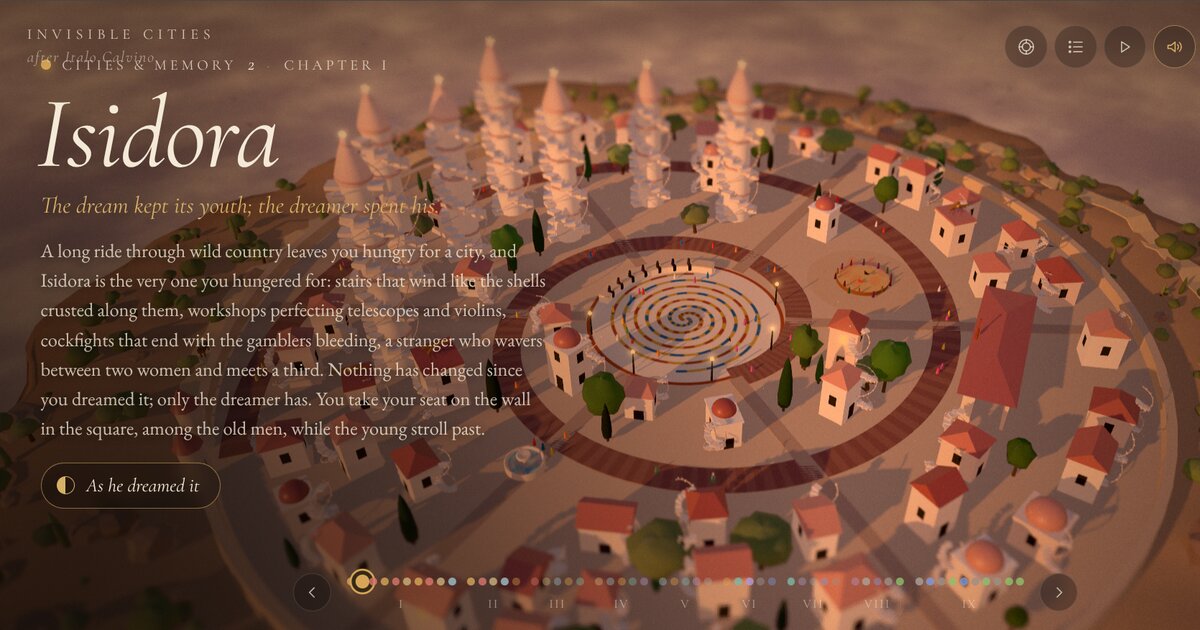
Piotr Migdał is right in his post. (opens in a new tab) As a data vis specialist (opens in a new tab), Piotr asks himself the question: What is my place in creating interactive media? And, after following his call to action (see post), I have one simple answer: yes.
Here are my results from repeating Piotr’s experiment.
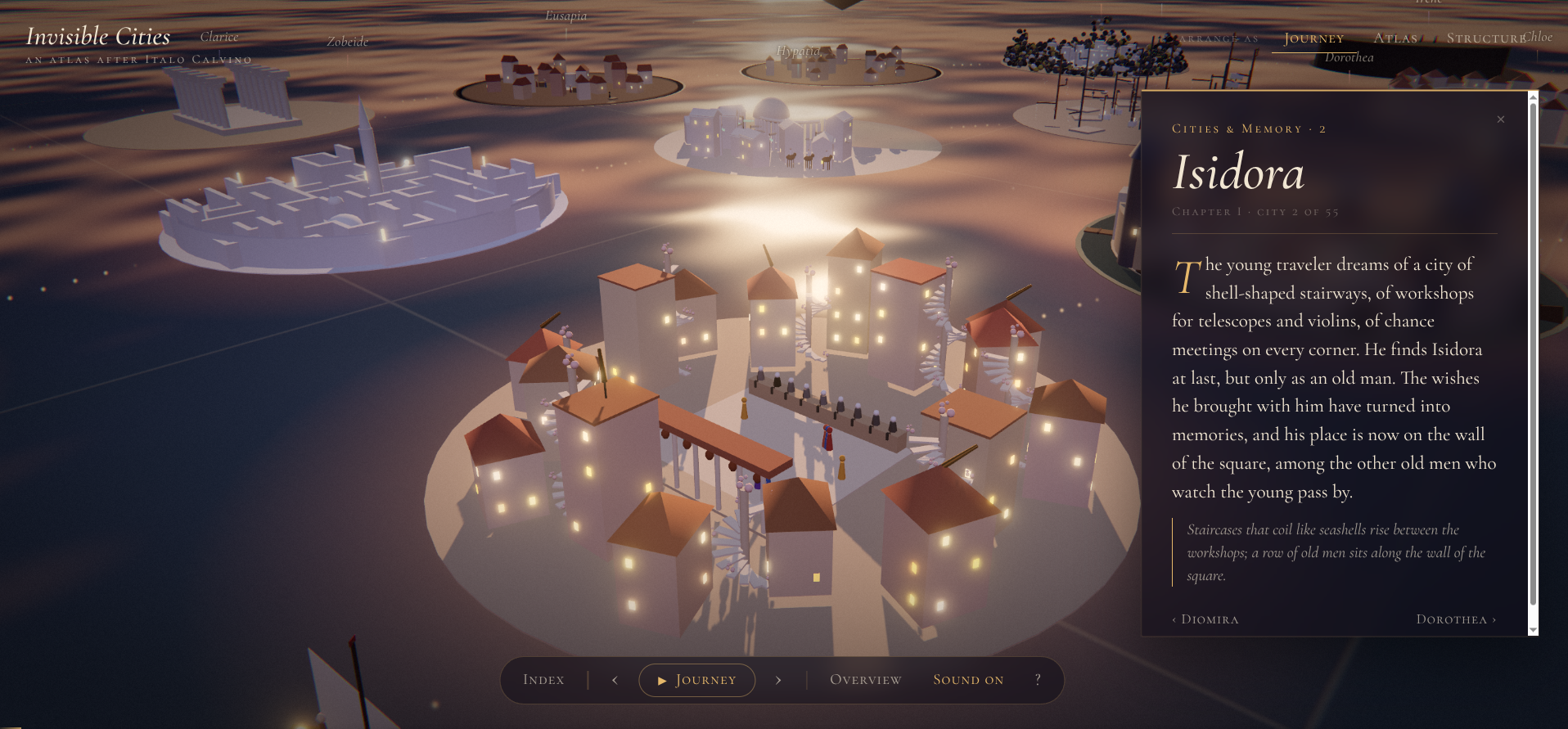
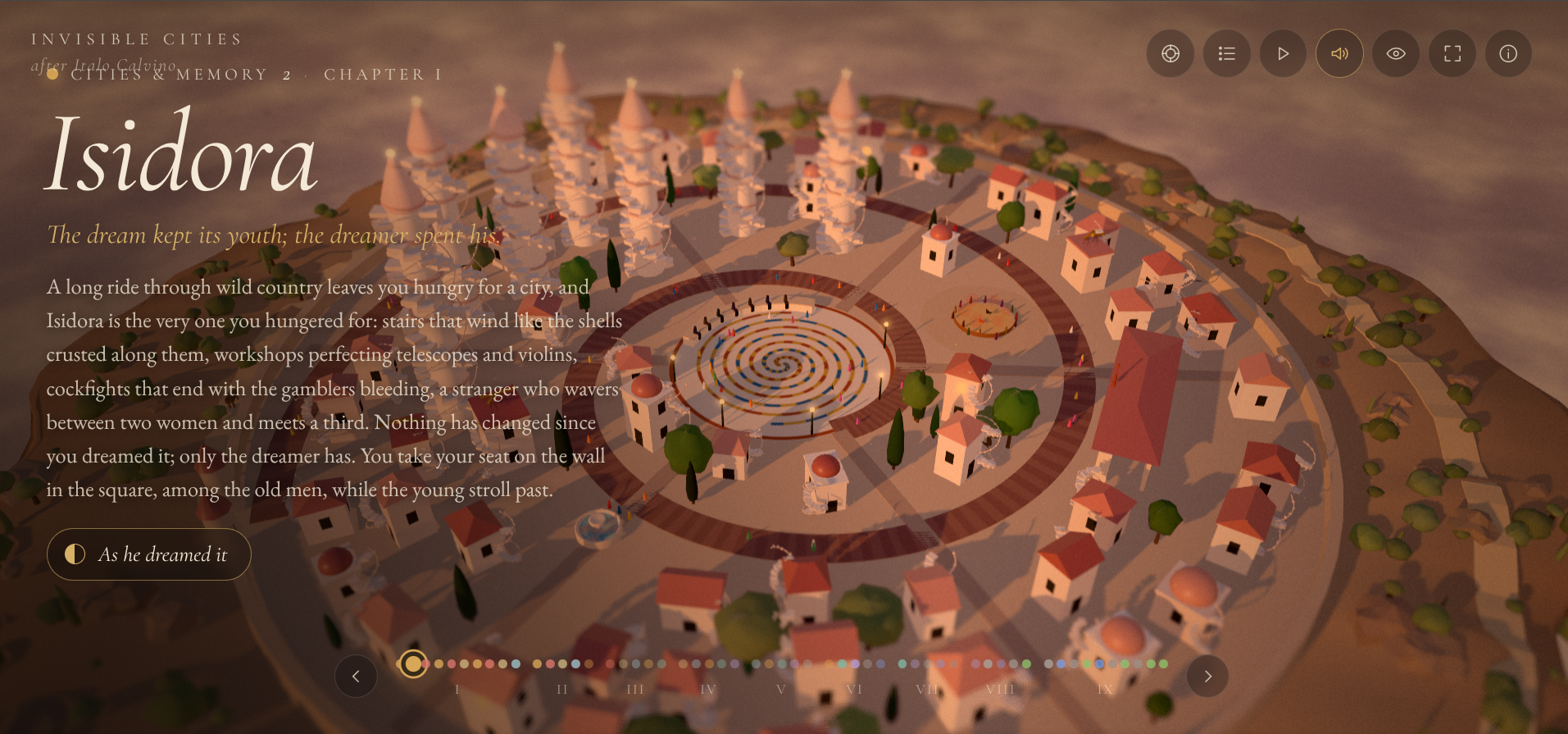
(Click on the picture to go to the interactive version)
 (opens in a new tab)
 (opens in a new tab)
Detailed results of my Claude Code + Opus 5.5 runs in the two configurations:
| Metric | medium effort | max effort + ultracode | Ratio (max / medium) |
|---|---|---|---|
| Total cost | $14.9800 | $264.6400 | 17.7x |
| Opus 5.5 cost | $14.9800 | $261.4700 | 17.5x |
| Haiku 5.5 cost | $0.0001 | $3.1700 | - |
| Metric | medium effort | max effort + ultracode | Ratio (max / medium) |
|---|---|---|---|
| Opus input tokens | 402 | 637,693 | ~1,586x1 |
| Opus output tokens | 313,168 | 5,326,576 | 17.0x |
| …of which thinking | 69,578 | 3,655,322 | 52.5x |
| Opus cache read | 27,899,390 | 297,377,614 | 10.7x |
| Opus cache write | 392,035 | 18,013,330 | 45.9x |
| Haiku input / output | 1,215 / 23 | 5,668,132 / 374,003 | - |
| Web searches | 0 | 242 | - |
| API time (summed) | 0h 53m 4s | 16h 29m 10s | 18.6x |
| Wall time (active) | 2h 46m 45s | ~1h 50m 12s | 0.66x |
| Lines added | 7,746 | 31,387 | 4.1x |
Some notes:
- Wall time: the run hit the session limit on Oct 9 at 14:19 UTC and resumed on Oct 13 at 12:06 UTC. The ~1h 50m adds the two working stretches (prompt to limit: 1h 4m 2s; resume to final answer at 12:53: 46m 10s) and leaves out the ~94h pause. The resumed stretch picks up with agents still building, and the log can’t tell whether any work happened during the pause, so this figure is approximate.
- API time: it adds up all parallel agents (about 11 city builders plus research agents). That’s why it is far higher than the wall time.
I hope you like the visualizations.
I’m not an Invisible Cities expert myself, and definitely not a data vis specialist. So, I’ll leave the review of the details of both artifacts to people who know more about those areas. What I can say for sure is that Piotr’s result (while using the same parameters) turned out a little better visually than mine, but in principle the results are very similar.
The max effort + ultracode version is even more stunning, but interestingly it never got mouse input working without errors. If you want to test it out, you need to stick to keyboard controls - see the Use chapter in the project’s README file.
And hey, if you are interested, the whole source code is in the repository, with the agents’ transcripts included!
Claude Opus 5.5, medium effort, no ultracode: [interactive] (opens in a new tab), [code] (opens in a new tab)
Claude Opus 5.5, max effort, with ultracode: [interactive] (opens in a new tab), [code] (opens in a new tab)
Of course, the title of this post is catchy. There is no real proof of Opus 5.5 causing an identity crisis for anyone. It’s just a real phenomenon that GenAI, in general, is causing it for some people already, and it started well before 2026.
I don’t know if Piotr identifies with the crisis, but I know that identity crisis is not a joke, Jim.

The picture is a funny meme, but the identity crisis is a serious thing.
In my bubble (IT), the issue of (some of the) programmers being upset with LLMs entering the game is pretty well known. However, not everyone realizes that what we observe is an identity crisis.
I watched numerous YouTube videos and read many social media posts and blog posts by programmers about a profound sense of alienation, loss of human dignity, and anger over stolen independence.
And you know what? You can find the same in texts from the 18th and 19th centuries - the Industrial Revolution. Back then, the term identity crisis didn’t yet exist, but the feelings and psychological problems were the same. There was no social media, no YouTube, but you can read autobiographies of working-class people.
Historians have analyzed hundreds of autobiographies written by working-class citizens during the Industrial Revolution (such as those collected by Emma Griffin in her book Liberty’s Dawn (opens in a new tab)). Additionally, workers frequently petitioned governments regarding how machines stripped away their identities as skilled artisans.
So we’ve already been there. Maybe, from history, we can learn how to deal with the status quo and cope with the situation?
Eventually, everything should be fine. The technology will be more powerful, and the job will still be there, it’ll just look different.
But some people are still anxious about the future.
Today, programmers are not the only group falling into that area of anxiety.
I’ve written before about mathematicians already relating to the identity crisis of programmers (opens in a new tab). But, sooner rather than later, it’ll apply to all scientists and white-collar workers.
While some scientists find autonomous AI agent swarms “extremely damaging” (opens in a new tab), others use armies of AI agents to “solve physics” (opens in a new tab).
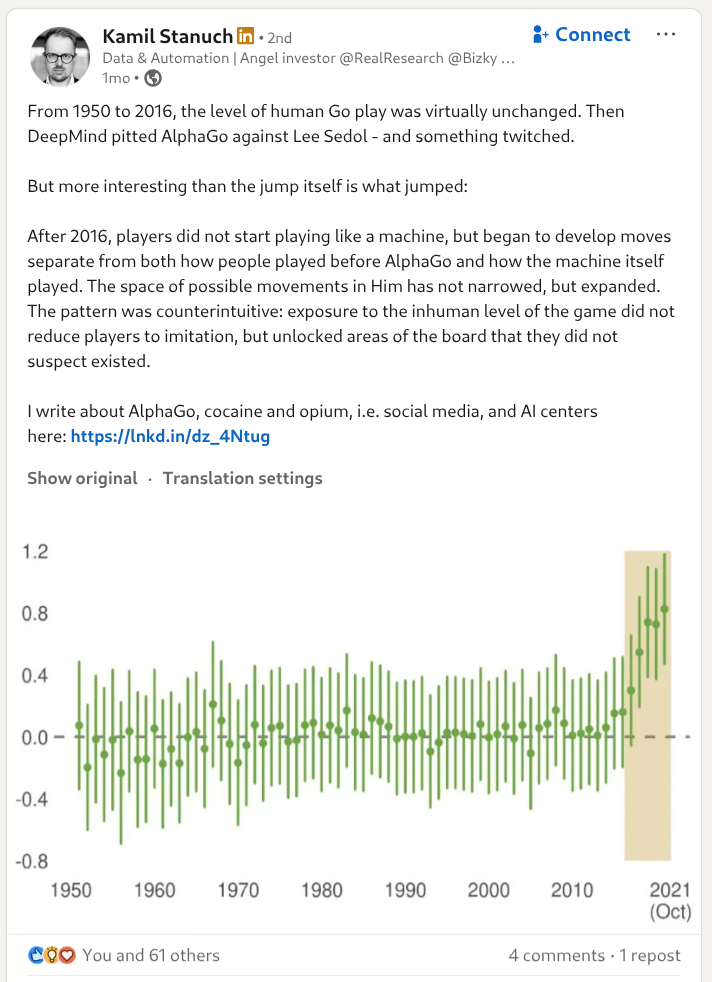
But the future looks brighter than that. We already know what AlphaGo did to the Go players (opens in a new tab), and I tend to expect the same, for every skill on which AI will have influence.
 (opens in a new tab)
This is the first post of my new blog.
After almost 10 years of this site, I’ve decided now is the time to have my own (work-related) blog, just like a few of my colleagues.
Expect occasional posts, but concise (opens in a new tab) ones: interesting data, insights, latest trends.
Hopefully I did well this time!
Follow me on LinkedIn (opens in a new tab) or Twitter (opens in a new tab), where I will sometimes link my blog posts.
Input tokens count only the uncached part of the prompt. Almost all input was served from the cache (see the cache rows), so the medium-effort baseline is tiny and this ratio overstates the difference in workload.↩︎